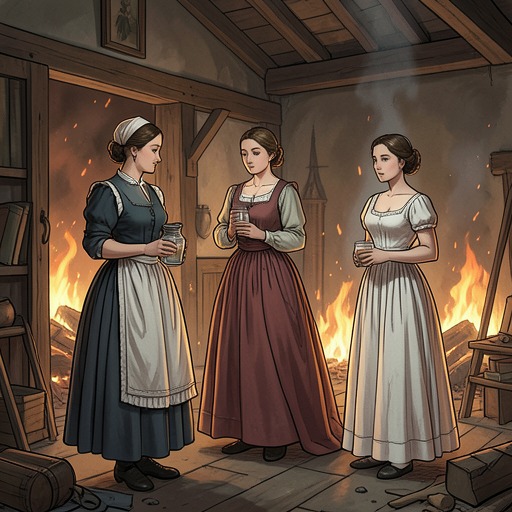
Adèle Anger and Petro’s Marriage
Felix AustriaAdèle Anger and Petro’s marriage is a partnership shaped by social convention, private intimacy, and an unequal household economy. As Stefania Tchornenko recounts it, Petro and Adèle build a shared life whose beauty and apparent unity depend heavily on her unacknowledged care; their marriage becomes closer after Adèle’s childlessness, even as Petro increasingly challenges Stefania’s continuing place beside her.
Marriage and Household
Adèle is drawn to public entertainments and takes Stefania with her, despite the whispered judgment of young women who gossip that a married woman brings her maid to dances. Petro does not accompany Adèle to these occasions, and Stefania feels unable to leave her alone. The marriage is thus presented from the outset as a domestic bond with a conspicuous gap: Adèle’s social life is accompanied by her servant, while her husband remains absent.
That division persists in private. During the couple’s honeymoon through Krakow, Budapest, and Vienna, Petro resents Stefania’s presence and, for much of the month, behaves as if she does not exist. Yet Stefania arranges their hotel meals to suit Adèle, obtains fresh cream for her coffee, and attends to her hair and clothes. These tasks are not incidental to the couple’s comfort: Stefania’s labor shapes the conditions of their travel and the bodily care surrounding their intimacy.
Adèle confides that Petro is captivated by the scent of her skin, lingering with his face at her neck and leaving red marks with his beard. Stefania covers the marks with lavender cream. She also prepares Adèle’s baths, brings scented salts and oils, and rubs her with herbal infusions. The physical closeness between husband and wife is therefore narrated alongside the care work that makes Adèle’s body and surroundings ready for it, a juxtaposition that exposes how the marriage’s private intimacy is entangled with Stefania’s service.
Intimacy, Childlessness, and Change
At the baths in Budapest, Adèle tells Stefania that Petro has asked to meet her alone in another room. Stefania conceals her distress as Adèle disappears between the columns, then later flees the couple at the Prater and walks by the Danube Canal. Her moment of calm comes through an image of flowing water: she understands herself as continuing to flow while loving Adèle. When she returns to the hotel, Petro studies her face; she perceives interest and gentleness in his eyes. She takes this as a sign that he will permit her to remain close to Adèle, although she recognizes that he will decide who may see his wife.
The account later makes clear that Adèle cannot become the mother of Petro’s children. Stefania believes Petro would be justified if he chose to leave, and she feels tenderness toward him, considering him worthy of Adèle and insisting that he has done them no harm. Petro does not abandon the marriage. Instead, Stefania describes him as remaining firm and unchanged while Adèle’s manner toward him shifts: she lays her palm on his large, rough hand at dinner, and her look takes on a doglike fidelity that distresses Stefania even as it saddens her.
Stefania interprets the change as a new sense of shared identity. Unable to bring a third person into the world, Adèle and Petro seem to her to believe that they have become one being. The marriage’s intensified closeness is thus not presented as uncomplicated fulfillment. Its new unity follows a loss, and Stefania’s description makes the couple’s joined identity feel both intimate and troubling.
Work, Care, and Conflict
Petro’s work gives the marriage a public and material presence. A sculptor of funerary statues rather than a coffin manufacturer, he makes mournful angels and marble figures for tombs and vaults. He later builds the couple’s striking house, while Stefania describes his attention turning more readily to sculpting cherubim for the chapel of the Resurrection of Christ at the penitentiary than to maintaining the home. The house leaks; Stefania changes the buckets collecting rainwater while also cooking, cleaning, carrying Petro’s lunch to the cathedral or prison chapel, buying provisions, massaging Adèle, and preparing iron-studded apples to ease her anemia.
This division of work becomes a source of direct conflict. When Adèle is upset, Petro insists that the couple do not need a servant and that Adèle can manage on her own. Stefania and Adèle laugh at the claim because Adèle cannot even light the kitchen fire. Their laughter briefly joins them in recognizing the absurdity of the idea, but Petro’s position is not merely teasing: he says they can find another servant who will work quietly and will not try to get into their bed. Stefania hears this as an accusation and as a threat to separate her from Adèle.
Petro then tells Adèle that he will find Stefania a room and take care of her, and that he has already spoken with landlords on Belvedere Street or Sedelmeyer Street. Adèle reports this through renewed trembling and tears. Stefania gives her a sleeping draught and takes her to her room, remaining awake through the hot night. The dispute reveals that Petro’s authority over the household includes the power to determine whether Stefania may continue living near his wife, while Stefania regards separation as a danger to Adèle as well as to their own bond.
The House and the Marriage’s Public Face
The house Petro begins building after Adèle’s changed attachment to him is an eccentric, conspicuous object in the city. Its wavering, bulging form resembles a giant snail shell, and its narrow windows and colorful ceramic tiles coil around walls, doors, columns, cornices, and arches. By contrast with the newer brick houses decorated with turrets, mosaics, and colored glass, it appears to Stefania like a mirage or a magic trick. Passersby gather to look at it, while she continues kneading dough or preparing herbal decoctions inside.
Its artistic inventiveness does not make it self-sustaining. In a season of extraordinary rain, underground currents strike the walls and roof, and water threatens to wrench the house from its foundations. Stefania’s daily work of changing buckets gives the marriage’s architectural fantasy a practical underside: Petro makes the house, but she bears much of the burden of keeping it habitable.
The home also contains images that extend Petro’s art into domestic space. Hidden behind the chimney sits a carved sandstone woman, which Petro calls the jar-woman; from below, he watches it through the glass roof of the salon. That ceiling represents a star map, with colored panes and copper divisions forming constellations, planets, and a comet with a fiery tail. These details make the house a shared artistic creation, but the account does not treat its symbolism as a substitute for the strained work of living in it.
A Marriage Sustained by Unequal Labor
The couple’s later public life still carries the marks of their shared artistic world. At a glass-and-wood dining pavilion in the Empress Elisabeth Park, Petro and Felix present Adèle with a charcoal portrait. Petro credits Felix with the drawing and says he contributed only a few corrections. Adèle’s expression in the portrait is solemn, almost prayerful, a face Stefania says she has often seen lately. The scene places Petro beside Adèle in a public celebration of her image, while Stefania remains the narrator who observes and interprets what that image means.
The marriage is consequently neither only an alliance between husband and wife nor a simple opposition between them and the servant. Adèle and Petro share sensual closeness, a home, and a growing sense of unity; Petro’s sculptural practice gives their household its distinctive form. Yet Stefania supplies essential care, and Petro’s attempts to dismiss her expose how precariously that household depends on labor it can also treat as replaceable. Their marriage’s apparent wholeness is sustained by an intimate triangle, even as Petro’s authority repeatedly threatens to break it apart.